
Vikram (with rover 'Pragyan' housed inside) is expected to touch down on the lunar surface on September 7, between 1.30 am and 2.30 am.
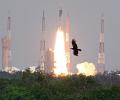
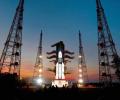
According to the Indian Situational Space Awareness Report for 2023, the nominal lift-off of the Launch Vehicle Mark-3, carrying the Chandrayaan-3 spacecraft, had to be delayed by four seconds based on the Collision on Launch Avoidance analysis.
The nine-second de-orbiting or retro-orbiting manoeuvre was executed at 3.42 am using the onboard propulsion system.
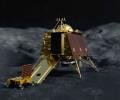
A complaint was lodged against the accused Mitul Trivedi, after he was seen giving interviews to the local media since the Vikram lander successfully made soft landing on August 24, claiming to have designed the lander module of Chandrayaan-3, the official said.

China's first moon rover is back to work after a "nap" and has succeeded in sending back the first images of the national flags on itself and the lander, space authorities said on Sunday.

I urge you all to watch the special moments of Chandrayaan-2 descending on to the Lunar South Pole! Do share your photos on social media. I will re-tweet some of them too," the prime minister wrote on Twitter.
Of the 109 lunar missions during the period, 61 were successful and 48 had failed, it stated.

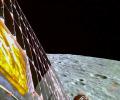
There will be two more orbit manoeuvres to make the spacecraft enter into its final orbit passing over the lunar poles at a distance of about 100 km from the Moon's surface.

The Indian Space Research Organisation (ISRO) has received approval for the Chandrayaan-5 mission, which aims to study the Moon's surface using a 250kg rover. The mission will be conducted in collaboration with Japan. This follows the success of the Chandrayaan-3 mission, which achieved a soft landing on the Moon's South Pole in August 2023. ISRO is also planning to establish a space station, Bharatiya Space Station, in the near future.

NASA posted images clicked by its Lunar Reconnaissance Orbiter camera, showing the site's changes on the Moon and the impact point before and after the spacecraft had made a hard-landing on the lunar surface.
The Lander and the Rover have scientific payloads to carry out experiments on the lunar surface. The main function of the Propulsion Module (PM) was to carry the Lander Module (LM) from the launch vehicle injection till final lunar 100 km circular polar orbit and separate the LM from PM, which it did.

The Chang'e-4 spacecraft scripted history on Thursday when it made the first-ever soft landing on the far side of the moon.
New data from India's Chandrayaan-3 mission suggests that ice might be present at more locations on the Moon's surface than previously believed. The study, published in Communications Earth and Environment, analyzed temperature data collected by the ChaSTE probe onboard the Vikram lander. The researchers found that significant variations in surface temperatures can influence the formation of ice, with slopes angled away from the Sun potentially providing favorable conditions for ice accumulation. The findings have implications for future lunar exploration, suggesting that water-ice resources could be more accessible than previously thought.
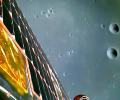
Taking to X (formerly Twitter), ISRO said, "Chandrayaan-3 Mission. Chandrayaan-3 Rover to MOX, ISTRAC, Moon walk begins!"

Chandrayaan-3 mission's rover 'Pragyan' has traversed a distance of about eight metres on the lunar surface, and its payloads have been turned on, ISRO said on Friday.

Its duties include experiments to further understand the lunar surface.

Glimpses of what the historic Chandrayaan Mission discovered on the dark side of the Moon.
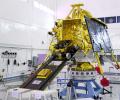
The cubical vehicle, exclusively designed for travelling on the moon, is fitted with a solar panel.

India will become the fourth country to master the technology of soft-landing on the lunar surface after the US, China and the erstwhile Soviet Union.

After the successful deployment of Chandrayaan-3's lander and rover on the moon, Indian Space Research Organisation (ISRO) is hoping that their mission life will not be limited to one lunar day or 14 earth days, and that they will come back to life when the sun again rises on the Moon, to carry on with the experiments and studies there.

ISRO chairman G Madhavan Nair said Chandrayaan-2, to be undertaken by 2010, will have a proper lander, which would land on the lunar surface and try to explore the surface in far more detail.

Vikram and Pragyan payloads are now in a power-off mode until the south pole of the lunar surface is back in the range of the Sun again.

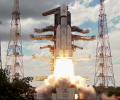
The Indian Space Research Organisation (ISRO) on Thursday announced that its lunar mission Chandrayaan-3 will be launched on July 14 from the space port at Sriharikota in Andhra Pradesh.

India's ambitious third Moon mission's spacecraft Chandrayaan-3 after the launch on July 14, had entered into lunar orbit or the Moon's orbit on August 5.

The spacecraft will now prepare for separation of the lander module -- comprising the lander and rover -- from the propulsion module.

The entire process being autonomous when the lander has to fire its engines at the right times and altitudes, use the right amount of fuel, and scan of the lunar surface for any obstacles or hills or craters before finally touching down.

Here is a glimpse of the journey of India's third lunar exploration venture has taken so far.

India created history on Wednesday when the lander module of Chandrayaan-3 touched down on the lunar south pole, propelling the country to an exclusive club of four and making it the first country to land on the uncharted surface.

ISRO Chairman S Somanath had recently said the most critical part of the landing will be the process of reducing the velocity of the lander from 30 km height to the final landing, and the ability to reorient the spacecraft from horizontal to vertical direction. "This is the trick we have to play here," he said.
Conducting in-situ scientific experiments is underway. All payloads are performing normally, ISRO said.

The ISRO on Monday released images of the Lunar far side area captured by the Lander Hazard Detection and Avoidance Camera (LHDAC).

Friday's mission is the fourth operational flight of LVM3 which aims to launch the Chandrayaan-3 spacecraft into a Geo Transfer Orbit.

China's first lunar rover on Saturday successfully landed on the moon, making the communist giant one of three world powers to make a "soft landing" as part of an ambitious programme that aims to put a Chinese astronaut on the moon.

Here is ISRO's SAC Director, Nilesh M Desai explains the crucial stage of soft landing.
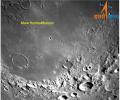
This camera that assists in locating a safe landing area -- without boulders or deep trenches -- during the descent is developed by Ahmedabad-based Space Applications Centre (SAC), a major research and development centre of ISRO.

"The receiver is kept on. Hoping for a successful awakening for another set of assignments! Else, it will forever stay there as India's lunar ambassador," it said.
As scientists at the Indian Space Research Organisation (ISRO) gear up for the much-awaited soft landing of the Chandrayaan-3 spacecraft on the Moon's surface, the space agency may postpone the touchdown to August 27 in the event that health parameters of the lander module are found to be "abnormal", a senior official has said.

Chandrayaan 3 follows the Chandrayaan 2 mission which did not achieve the desired soft landing on the surface of the moon in 2019, disappointing the scientists.
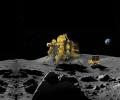
This eagerly anticipated event will be broadcast live on August 23, starting from 17:27 Hrs IST on multiple platforms, including the ISRO Website, its YouTube channel, ISRO's Facebook page, and DD National TV channel.

Luna-25 took off from the Vostochny launch facility in Russia's Far East, Russia-based TASS news agency reported.
